
Blog
History of Chocolate: Where It All Began


Before it was bars, truffles and steaming mugs on a winter morning, chocolate was sacred. Here’s how it all started.
Think about the last time you gave someone chocolate as a gift. Or treated yourself to a square, or three, after a long day. There’s something instinctive about reaching for chocolate in moments that matter. And it turns out there’s a very good reason for that. Humans have been doing exactly this for over two thousand years.
The Maya and the first cacao plantations
The Mayan civilisation flourished between roughly 250 AD and 900 AD, with roots stretching back as far as 600 BC. Across their territories, from the Yucatán Peninsula to the Pacific coast of Guatemala, some of the earliest known cacao plantations were cultivated and carefully tended.
To the Maya, cacao wasn’t simply a crop. The pods were symbols of life and fertility, their significance carved into temples, painted onto pottery, and woven into the fabric of daily ritual. Cacao beans were treasured, exchanged as gifts, used in religious ceremonies, and offered on special occasions.
Sound familiar? The instinct to give chocolate hasn’t changed much in two thousand years.
Quetzalcoatl and the gift of cacao
By the 1200s AD, the mythology surrounding cacao had grown into something extraordinary. According to Aztec legend, the god Quetzalcoatl descended from heaven on the beam of a morning star, carrying with him a cacao plant stolen from paradise. He planted it in the earth and asked Tlaloc, the god of rain and water, to nurture it.
Once the plant bore fruit, Quetzalcoatl taught humans how to harvest the seeds, roast and grind them, then whisk them with water to create a rich, bitter drink. Which sounds, honestly, rather wonderful. Though the catch was that this particular drink was reserved strictly for priests and nobles , so not exactly one for everyone.
Cacao seeds were used as currency, traded for goods, offered to the gods, and believed to be a source of wisdom, power and love. |
Currency, power and Montezuma’s 50 goblets a day
For the Aztecs, cacao took on an even more central role. Cacao seeds became a form of currency – used to buy goods, pay tribute to rulers, and make offerings to the gods. They were considered a source of wisdom, power, and nourishment. Emperor Montezuma reportedly consumed as many as 50 goblets of thick, spiced cacao every single day. Which suggests he either had extraordinary focus or an extraordinary caffeine tolerance. Probably both.
From bowl to froth, an ancient ritual
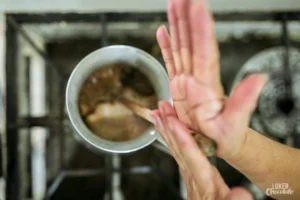
Both the Maya and the Aztecs prepared their cacao drink in a similar way: roasting the beans, grinding them into a thick paste, then mixing with water, dried flowers, chilli, honey, and spices. The drink was then poured repeatedly between bowls from a height to create a rich, foamy froth on top.
That technique isn’t entirely lost. The molinillo, a beautifully carved wooden whisk, is still used across Latin America today to froth hot chocolate by hand, and traditional clay jugs designed to sit directly over a flame are still found in Mexican and Colombian homes. The ritual has evolved, but the intention hasn’t: to make something worth slowing down for.
Stories still alive in the cacao fields
What’s remarkable is how much of this mythology is still being passed on. As part of our Chocokids programme in Colombia, run in partnership with our cocoa supplier Luker Chocolate, the team recently held an Ancestral Myths and Legends workshop, where children and young people in cacao-growing communities explored the difference between myths and legends, and heard the old stories that have been shared during harvest seasons for generations.

These aren’t just folktales. They’re a form of cultural inheritance – the knowledge, tradition, and meaning that travels alongside cacao from generation to generation. The legend of Quetzalcoatl is still being told in the same communities where our cocoa is grown today.
A modern ritual, rooted in something old
The way we make and drink chocolate has changed enormously. Most hot chocolate today is made from powder – quick, convenient, and a long way from anything the Maya would recognise. But the impulse behind it, to make something warming, indulgent, and worth sharing, is exactly the same.
At Choc Affair, we make our hot chocolate from 5kg bars of chocolate, flaked and bagged into our pouches, because we think the flavour of properly made chocolate deserves to be tasted properly. No shortcuts, no fillers, just real chocolate flakes, exactly as it should be.
The Maya were on to something way back then!
Try it for yourself Our hot chocolate range is made with luxury chocolate flakes, nothing added, nothing taken away. Shop the hot chocolate range here |
